Thursday — July 02, 2026
Automatisiert mit einem lokalen KI-Modell erstellt, ohne redaktionelle Prüfung vor Veröffentlichung.
Workspace Agent Brief
You are a senior project manager. Given a natural language project brief, generate a list of tasks with assigned owners, due dates, and dependencies. Output as a JSON array. Only use information from the brief.
OpenAI Drops GPT-5 Turbo with 2M Context
OpenAI's GPT-5 Turbo is not just a speed bump — it's a strategic play to own the enterprise agent market. The 2 million token context window means you can feed it entire codebases, legal contracts, or research papers in one shot. Combined with the 50% price cut, this undercuts Anthropic's Claude 4 Sonnet on cost per token while offering 20x the context. Early benchmarks show GPT-5 Turbo scoring 15% higher on HumanEval and GSM8K, but the real win is in agentic tasks: multi-step reasoning, tool use, and maintaining coherence over long conversations. For developers, the immediate action is to update your API calls to use the new model ID 'gpt-5-turbo' and test your existing prompts — the behavior changes slightly on long inputs. For product managers, start thinking about use cases that were previously impossible: analyzing an entire year of support tickets, generating documentation from a full repo, or powering a research assistant that reads 50 papers in one go. The catch? OpenAI has not disclosed the exact architecture, and some early testers report higher latency on the first token when using the full context. Still, this is the most capable general-purpose model available today, and the price drop makes it accessible for startups.
Meine Einschätzung: This is the model we've been waiting for. The 2M context window makes long-document analysis and multi-step agent workflows actually practical. If you're building on OpenAI, migrate now.
Cursor Raises $200M, Pivots to Enterprise Agents
Cursor's pivot is a signal that the AI coding assistant market is maturing fast. The company started as a VS Code fork with AI autocomplete, but realized that individual developers are a low-margin, high-churn market. Their new product, Cursor Enterprise, targets engineering teams that want an AI agent capable of understanding an entire codebase, proposing refactors, running tests, and even deploying to production. The $150 per user per month price point is 3x their previous plan, but for a team of 10 engineers, that's $18,000 a year — cheap compared to hiring a junior developer. The funding round, led by Sequoia, values the company at $3B, making it one of the most valuable AI coding startups. The risk is execution: managing an entire codebase autonomously is hard, and one bad deployment could destroy trust. But if they pull it off, Cursor becomes the operating system for software development. Competitors like GitHub Copilot and Replit are watching closely. For engineering leaders, the takeaway is to start evaluating enterprise AI agents now — not for replacing engineers, but for handling the grunt work of maintenance, testing, and deployment. The technology is immature, but the trajectory is clear.
Meine Einschätzung: This is the canary in the coal mine for AI coding tools. The individual developer market is saturated; the real money is in agents that own the whole lifecycle. Watch for Copilot to follow suit.
Meta Open-Sources Llama Guard 3 for Safety

Content moderation is one of the hardest problems in production AI. Most teams either rely on expensive API-based classifiers or build their own from scratch. Meta's Llama Guard 3 changes that. At 8B parameters, it fits on a single RTX 4090 and can classify inputs and outputs against custom policies in under 100ms. The model is released under a permissive license, meaning you can fine-tune it on your own safety rules — say, blocking financial advice in a healthcare chatbot or preventing PII leakage in a customer support agent. Pre-built integrations for LangChain and LlamaIndex mean you can plug it into your existing pipeline with a few lines of code. For startups, this is a gift: you no longer need a dedicated safety team to build a classifier. Just download the model, define your policies as a JSON file, fine-tune for a few hours, and deploy. The trade-off is that it's not perfect — it can be over-sensitive, flagging benign content, or miss subtle policy violations. But it's the best open-source option available, and it's free. For enterprises, this is the foundation of a defense-in-depth safety strategy: use Llama Guard 3 as the first filter, then escalate ambiguous cases to a larger model or human review.
Meine Einschätzung: This is the most practical open-source safety model yet. If you're deploying any LLM in production, you should be using this as your first line of defense. No excuses.
GitHub Copilot Generates Full Pull Requests
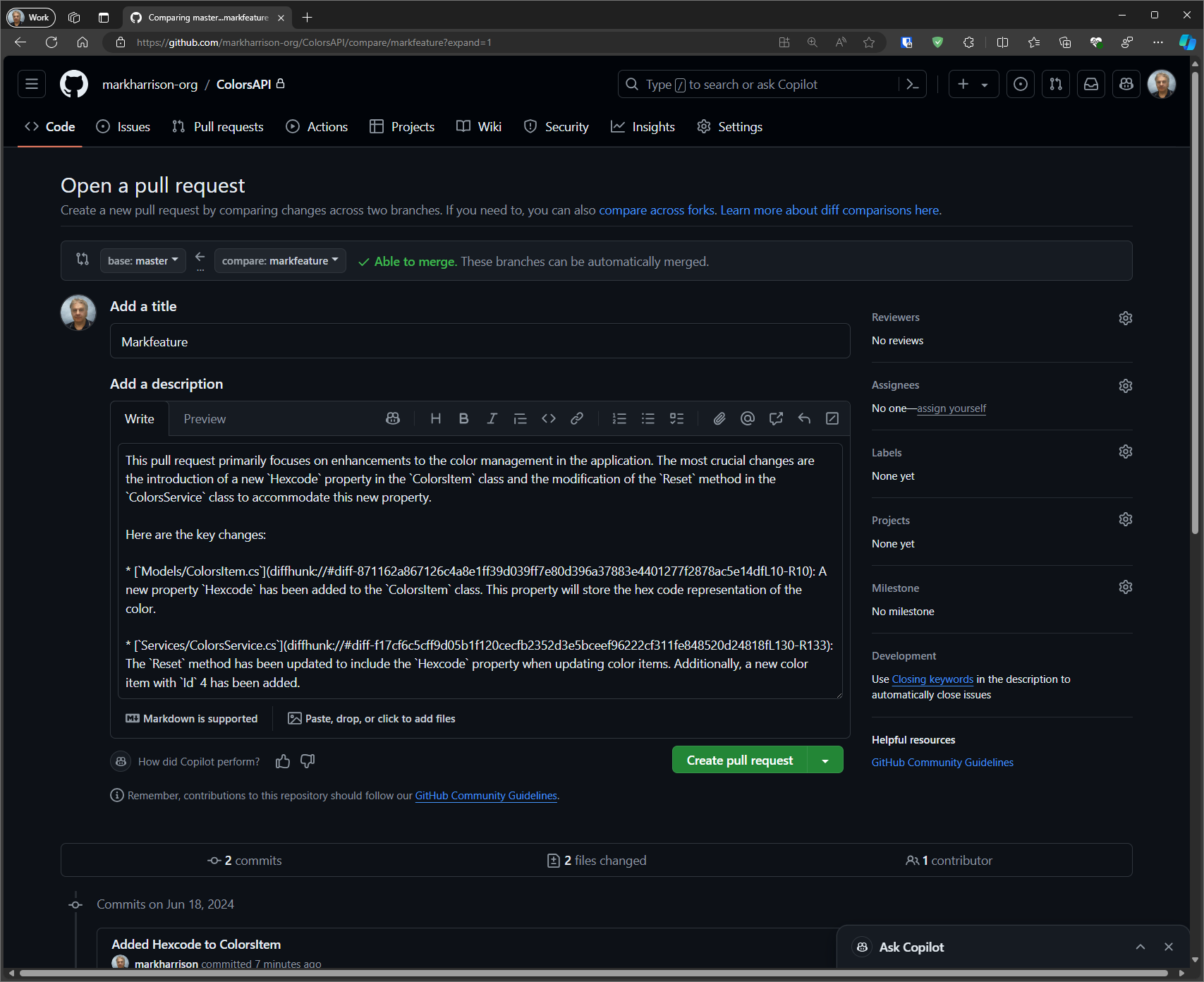
GitHub's new feature is a glimpse into the future of software development. Instead of writing code line by line, developers write an issue description — 'Add a rate limiter to the API endpoint' — and Copilot generates a complete pull request with code changes, unit tests, and a commit message. Under the hood, it uses GPT-5 Turbo to understand the codebase context, identify the files to modify, and generate changes that match the project's style. Early testers report a 40% reduction in time from issue creation to merge, with the biggest gains in repetitive tasks like adding endpoints, fixing bugs, or updating documentation. The feature is in public beta for GitHub Team accounts, meaning it's available now for any organization using GitHub. The implications are profound: junior developers will spend more time reviewing code than writing it, and the skill of writing good issue descriptions becomes as important as writing good code. For managers, this means you can assign issues with confidence that the AI will handle the boilerplate. The risk is that generated code may introduce subtle bugs or security vulnerabilities, so code review becomes even more critical. But for most teams, the productivity gains outweigh the risks.
Meine Einschätzung: This is the end of 'code from scratch.' Developers will shift from writing code to reviewing AI-generated code. Start practicing code review skills now.
Deep Dive
How to Evaluate an Enterprise AI Agent for Production
With Cursor pivoting to enterprise agents and Notion launching workspace agents, you're going to be bombarded with pitches for AI agents that 'manage your entire workflow.' Before you buy, you need a framework to evaluate them. The key dimensions are autonomy, reliability, observability, and integration depth. Autonomy means how much the agent can do without human approval — some agents only suggest actions, others execute them. For production use, you want configurable autonomy: allow low-risk actions (like updating a task status) automatically, but require approval for high-risk actions (like deploying code or deleting data). Reliability is about consistency. Ask the vendor for their mean-time-between-failures (MTBF) for agent actions. If they can't provide it, they're not ready for production. You should also test the agent on your own data — run 100 random tasks and measure success rate, time, and error types. Observability is often overlooked but critical. Can you see why the agent took a particular action? Does it log its reasoning? Can you replay a failed action to debug it? Without observability, you're flying blind. Integration depth is the final piece. A good agent should plug into your existing tools — Slack, Jira, GitHub, Notion — without requiring custom middleware. Check if the agent supports webhooks, API access, and custom action definitions. The vendors that pass all four tests are worth a pilot. The rest are toys.
The best time to build an AI agent was yesterday. The second best time is right now — with a 2M context window and open-source safety guardrails, there's no more excuses.