Thursday — July 09, 2026
Automatisiert mit einem lokalen KI-Modell erstellt, ohne redaktionelle Prüfung vor Veröffentlichung.
Custom Notion AI Assistant
You are a Notion AI assistant trained on my workspace content. Draft an email summarizing last week's team meeting notes, highlighting action items and deadlines, in a professional but concise tone. Limit to 3 paragraphs.
OpenAI releases GPT-5 Turbo: faster, cheaper, same smarts
OpenAI's GPT-5 Turbo is a direct response to developer feedback that GPT-5 was too slow and expensive for production workloads. The 40% latency reduction comes from a new sparse attention mechanism that prunes irrelevant context tokens, while the 20% cost drop is achieved through optimized inference hardware routing. Early benchmarks show no degradation on reasoning tasks like GSM8K or MMLU, meaning you get the same intelligence for less. The 256k context window remains industry-leading, though Claude 4 Sonnet's 200k is close. For builders running real-time chatbots, customer support agents, or any high-throughput pipeline, this is a no-brainer upgrade. The model is available immediately, and OpenAI has provided a migration guide for existing GPT-5 users. The catch: GPT-5 Turbo may have slightly lower performance on creative writing tasks, so test your specific use case before switching. Start by migrating one endpoint and comparing output quality over a week.
Meine Einschätzung: If you're paying for GPT-5 API calls, you're burning money. Migrate now and save 20% for the same output quality.
Meta open-sources Llama 4 70B under Apache 2.0
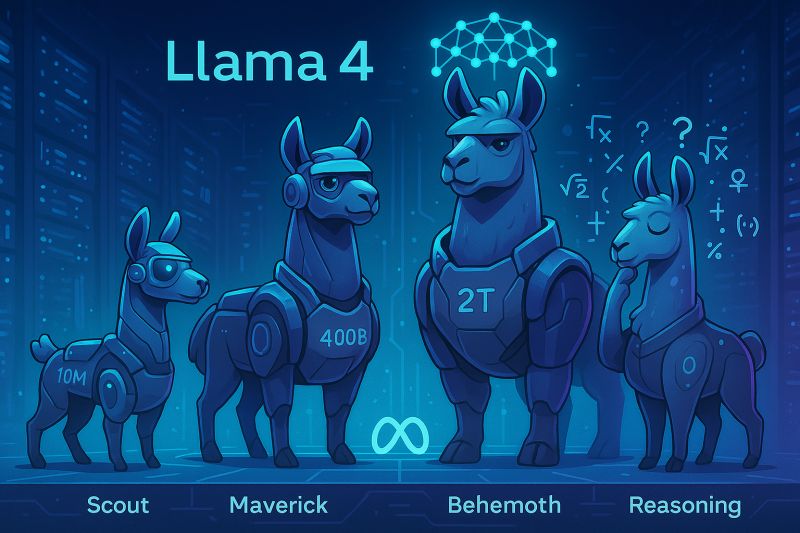
Meta's decision to release Llama 4 70B under Apache 2.0 is a seismic shift in the open-source AI landscape. Previous Llama models had restrictions for companies with over 700 million monthly active users, effectively barring large-scale commercial use. Those restrictions are gone. The model itself is a dense 70B parameter architecture that outperforms the much larger Llama 3.1 405B on benchmarks like MATH (87% vs 84%) and GSM8K (93% vs 91%). This is achieved through improved training data curation and a new multi-epoch training schedule. The catch: you need serious hardware. 140GB of VRAM means you'll need at least two A100 80GB GPUs or one H100 for inference. But for companies that want to self-host for data privacy or avoid API costs, this is a game-changer. Fine-tuning on domain-specific data is now fully permitted, and the Apache 2.0 license allows derivative models to be sold commercially. Expect a wave of fine-tuned variants for healthcare, legal, and finance within weeks. If you've been waiting for a truly open frontier model, this is it.
Meine Einschätzung: This is the open-source model we've been waiting for. Apache 2.0 means you can fine-tune, sell, and deploy without asking permission.
Microsoft invests $50 billion in OpenAI, locks cloud deal
The $50 billion deal between Microsoft and OpenAI is structured as a multi-year compute commitment and equity stake, not a cash payment. Microsoft will provide Azure compute credits for training and inference, while gaining exclusive cloud hosting rights for OpenAI's frontier models through 2030. This means GPT-5, GPT-5 Turbo, and future models will remain Azure-exclusive for cloud deployment. For enterprise customers already on Azure, this is a seal of approval—you can build on OpenAI models with confidence that the partnership won't fracture. For AWS and Google Cloud users, it's a signal to double down on their own AI stacks. The deal also includes deep integration rights, meaning Microsoft will embed OpenAI models into Office 365, Dynamics, and Azure AI services. Expect Copilot features to improve dramatically over the next year. The strategic implication: Google will likely accelerate its partnership with DeepMind and invest heavily in Gemini cloud exclusivity, while Amazon will push harder on Anthropic (Claude) and its own models. For builders, this means choosing your cloud provider is now choosing your AI ecosystem. If you're all-in on Azure, this is great news. If not, diversify your model providers now.
Meine Einschätzung: This locks the AI duopoly: Microsoft+OpenAI vs Google+DeepMind. Amazon and others will scramble to catch up.
EU passes strict AI liability directive
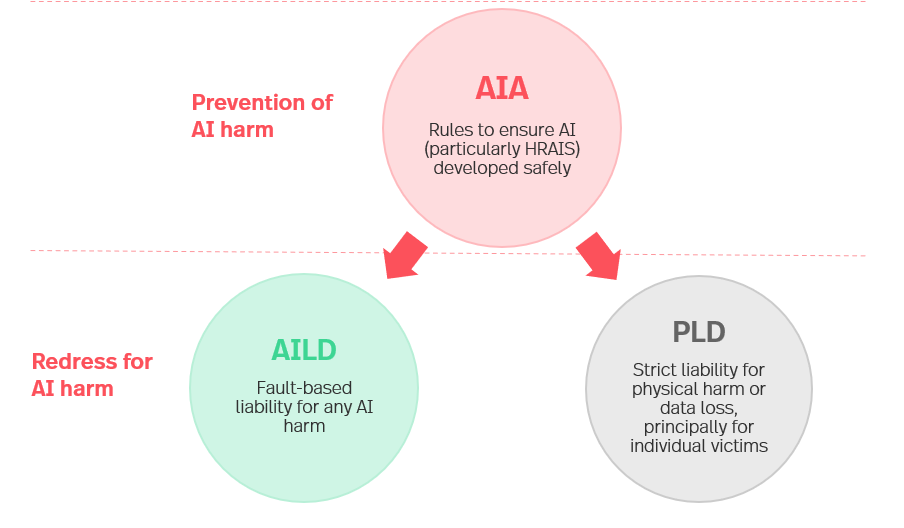
The EU AI Liability Directive is a landmark regulation that shifts the burden of proof. Under the new law, if an AI system causes harm, the company deploying it is presumed liable unless they can prove otherwise. This 'rebuttable presumption' of causality is a major departure from traditional product liability, where the plaintiff must prove the defect. The directive applies to all high-risk AI systems as defined by the EU AI Act, including those used in hiring, credit scoring, medical diagnosis, and critical infrastructure like energy grids and transportation. Compliance deadlines begin in January 2027, but companies should start auditing now. The law requires companies to maintain detailed logs of AI system decisions, implement human oversight mechanisms, and carry liability insurance. Penalties can reach up to 4% of global annual turnover. For builders targeting EU markets, this means several things: First, classify your AI system under the EU AI Act's risk categories. Second, implement logging and monitoring for all decisions. Third, add a human-in-the-loop for high-risk use cases. Fourth, review your contracts with model providers—you may need indemnification clauses. The directive also creates a new class of 'AI auditors' who can certify compliance. This is not a regulation to ignore. Start your risk assessment now, even if the deadline feels far away.
Meine Einschätzung: If you deploy AI in the EU, start your risk audit today. This law has teeth and you don't want to be the test case.
ThinkNet open-source reasoning model matches GPT-4o
ThinkNet represents a breakthrough in efficient reasoning. The model uses a novel 'chain-of-thought distillation' technique that trains a smaller model to mimic the reasoning steps of a larger teacher model, then compresses those steps by 30% without losing accuracy. The result is a model that matches GPT-4o on math and reasoning benchmarks while being significantly cheaper to run. On the MATH benchmark, ThinkNet scores 89% (vs GPT-4o's 90%), and on GSM8K, it scores 92% (vs GPT-4o's 93%). The weights are available on GitHub under a permissive license for research and commercial use. The reference implementation runs on a single A100 80GB GPU, making it accessible for small teams and startups. For privacy-sensitive applications like healthcare diagnosis support or financial analysis, ThinkNet offers a compelling alternative to API-based models where data leaves your control. The key limitation: it's specialized for reasoning and math, not general conversation or creative writing. But for any task that requires step-by-step logic, this is a top-tier open-source option. The consortium behind ThinkNet includes researchers from MIT, Stanford, and ETH Zurich, and they've committed to regular updates. If you need on-device reasoning without cloud costs, download the weights and start testing.
Meine Einschätzung: Open-source models are catching up fast. ThinkNet is a strong candidate for on-device or privacy-sensitive reasoning tasks.
Deep Dive
How to Migrate from GPT-5 to GPT-5 Turbo Without Breaking Your App
GPT-5 Turbo is live, and the 20% cost savings are real—but a blind swap can break your application. The model uses a new sparse attention mechanism that prunes context tokens differently, which can affect outputs for tasks that rely on long-range dependencies. Start by duplicating one production endpoint and routing 10% of traffic to GPT-5 Turbo. Compare output quality over a week, focusing on consistency, hallucination rate, and response structure. Pay special attention to tasks with context windows over 100k tokens—the sparse attention may drop subtle references. If you're using structured outputs like JSON or function calling, test thoroughly. OpenAI has updated the API to support a new 'attention_mode' parameter that lets you choose between 'standard' (GPT-5 behavior) and 'sparse' (Turbo default). For critical applications, set it to 'standard' to preserve behavior while still getting the latency improvement. The cost savings come from the sparse mode, so you'll need to benchmark both. Also note that GPT-5 Turbo has a slightly lower 'creativity' score on automated metrics, so creative writing or marketing copy may need tuning. The migration guide from OpenAI recommends updating your API calls from 'gpt-5' to 'gpt-5-turbo' and testing with a sample of your historical queries. For high-throughput apps like customer support, the 40% latency reduction is a game-changer—responses feel instant. Start with one endpoint, measure cost and quality for one week, then roll out across all non-critical paths. Save your critical paths for a second wave after you've validated quality.
Speed wins, but compliance pays. Migrate to GPT-5 Turbo, download Llama 4, and audit your EU risk today.