Saturday — July 11, 2026
Automatisiert mit einem lokalen KI-Modell erstellt, ohne redaktionelle Prüfung vor Veröffentlichung.
Agentic Web Scraper
You are an AI agent tasked with gathering competitive intelligence. Given a list of target URLs, extract pricing, feature sets, and release dates for all AI coding tools mentioned. Output a structured JSON table with columns: tool_name, pricing_per_million_tokens, key_features, release_date. Only include verified data from the page source.
OpenAI Drops GPT-5.6 Family with Tiered Pricing
OpenAI's GPT-5.6 family is its most strategic release in months. By offering three distinct tiers, they're trying to cover every budget while keeping the flagship premium. Sol's 91.9% on Terminal-Bench 2.1 is a genuine achievement — that benchmark tests real-world terminal command execution, not just academic trivia. The 54% token efficiency gain for coding means you'll spend less per task, even at the higher per-token price. GPT-Live is the sleeper hit here. Full-duplex voice — where the model can listen and speak at the same time — is a game-changer for customer service bots, real-time translation, and any application where latency kills the experience. It's rolling out globally, which suggests they've solved the infrastructure scaling issues that plagued earlier voice models. For builders, the immediate takeaway is to evaluate Luna for high-volume, low-complexity tasks. At $1 per million input tokens, it's competitive with open-source models while offering OpenAI's reliability. Save Sol for the hard stuff — complex code generation, multi-step reasoning, and anything where a mistake costs more than the token price.
Meine Einschätzung: OpenAI is segmenting the market aggressively — Sol for the enterprise whales, Luna for the rest of us. The tiered pricing is a direct play to stop users from defecting to cheaper alternatives like DeepSeek and Meta.
Cloudflare to Block All AI Bots on New Domains
Cloudflare's decision to block AI bots by default on new domains is a tectonic shift in the web's accessibility landscape. Starting September 15, any new domain that uses Cloudflare — and that's millions of sites — will automatically block AI agent bots and training bots. Traditional search crawlers like Googlebot will still work. This means the era of indiscriminate web scraping for AI training and agent actions is ending. For builders, this creates immediate problems. If your agent relies on browsing the open web to answer questions or complete tasks, you'll hit Cloudflare's wall on a huge percentage of sites. The workaround isn't simple — you can't just change your user-agent string because Cloudflare's bot detection goes deeper, analyzing behavior patterns, IP reputation, and TLS fingerprints. The strategic implication is clear: AI systems need to shift from scraping to API-based data access. If you're building an agent that needs web data, you should start negotiating direct data partnerships or building your own indexed datasets now. For the open web, this could accelerate the move toward authenticated, paid access to high-quality content — a model that benefits publishers but raises costs for AI builders.
Meine Einschätzung: This is the biggest news today that no one is talking about enough. If you're building AI agents that scrape the web, you just lost the default playing field. Cloudflare protects roughly 20% of all websites — this is an extinction-level event for careless crawlers.
Meta Launches Muse Spark 1.1 as First Paid Coding Model
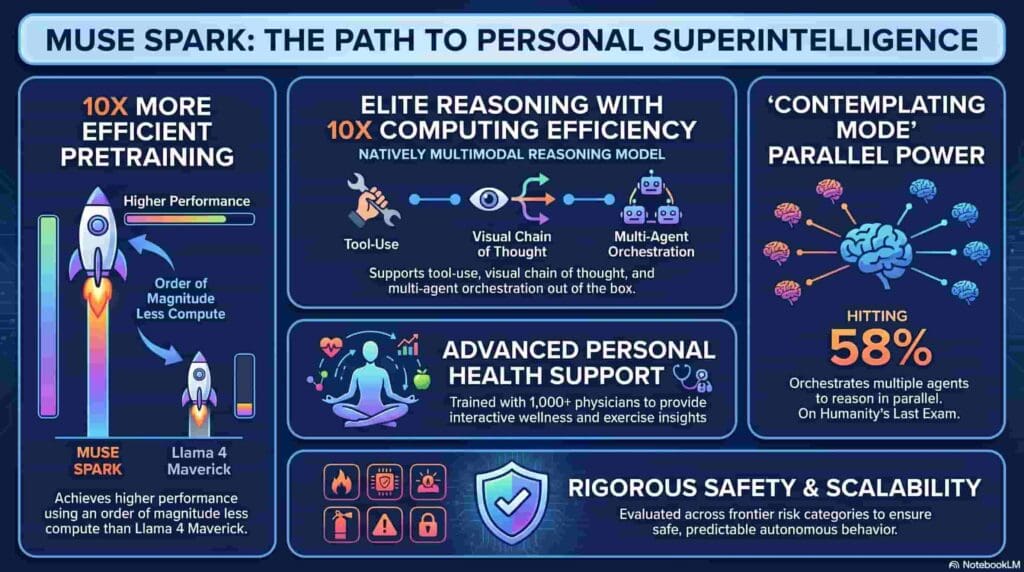
Meta's Muse Spark 1.1 marks a significant strategic pivot. For years, Meta gave away its AI models for free, building goodwill and an open-source ecosystem. Now they're entering the paid tier, but at a price that screams 'land grab.' At $1.25 per million input tokens and $4.25 per million output tokens, they're undercutting Grok 4.5 and Claude Opus by a wide margin. The model itself is no slouch. It supports multi-agent workflows natively, meaning you can spin up multiple specialized agents that coordinate on complex tasks. The native multimodal perception — handling images, video, and documents without separate preprocessing — reduces integration complexity significantly. It now powers Meta AI's Thinking mode, which suggests it's their internal reasoning workhorse. The kicker is the promised open-source release. Meta has a pattern: release a capable model commercially, collect feedback and usage data, then open-source a variant that benefits from that real-world training. If you're building a coding assistant, Muse Spark 1.1 is worth testing today, but plan for the open-source version in your long-term architecture. The risk is vendor lock-in on a model that might become free in six months.
Meine Einschätzung: Meta is playing the long game — release a paid model now, gather enterprise data, then open-source it later to capture the community. At this price point, they're not trying to make money; they're trying to take market share from OpenAI and Anthropic.
GitHub Copilot CLI Gets MCP Integration and Redesign
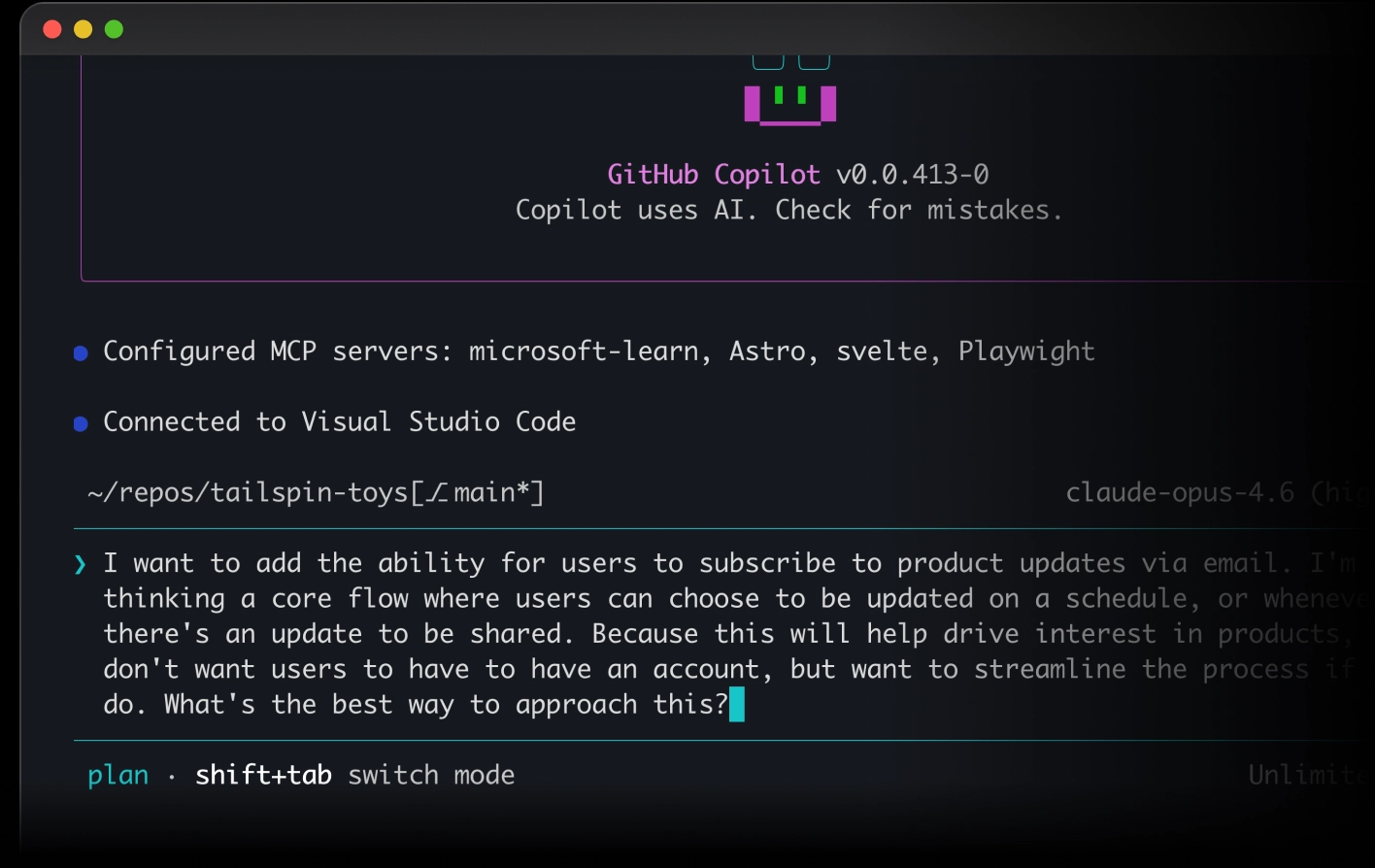
GitHub's update to Copilot CLI is more than a facelift. The new tabbed interface is nice, but the killer feature is native MCP (Model Context Protocol) integration. With /mcp add, you can connect Copilot to any tool that exposes an MCP server — databases, APIs, deployment pipelines, testing frameworks. The /mcp search command lets you discover and install servers without leaving the terminal. This transforms Copilot from a passive autocomplete tool into an active agent that can execute multi-step workflows. Imagine telling Copilot to 'deploy the latest commit to staging, run the test suite, and if tests pass, create a PR' — and it does all of that by orchestrating MCP-connected tools. The GitHub Mobile update is smaller but meaningful — better filtering and sorting for Copilot sessions means you can review and manage your AI-assisted work on the go. For developers, the immediate action is to explore the MCP ecosystem. Start with the official GitHub MCP server, then add your CI/CD pipeline, database, and cloud provider. The productivity gains compound as you add more tools.
Meine Einschätzung: The MCP integration is the real news here. It turns Copilot from a code completion tool into an agentic platform that can orchestrate external tools. If you're not using MCP yet, this is your sign to start.
Mistral Open-Sources Leanstral 1.5 for Theorem Proving
Mistral's Leanstral 1.5 is not for everyone, but for those who need it, it's transformative. At 119B parameters with only 6B active per inference, it's a Mixture of Experts model that's efficient enough to run on consumer hardware while delivering state-of-the-art results on theorem proving and code verification. It's designed to work with Lean 4, the interactive theorem prover used by mathematicians and formal verification engineers. The Apache 2.0 license means you can use it for commercial projects, modify it, and even sell services built on top of it. The practical applications are broader than they sound. Automated theorem proving isn't just for math PhDs — it's for verifying that your smart contract won't have a reentrancy bug, that your medical device software won't enter an infinite loop, or that your autonomous vehicle's decision logic is sound. Mistral also released a free API endpoint, which lowers the barrier to entry. For builders in safety-critical domains, this is the most important open-source release of the year. Start by using the free API to verify small code snippets, then consider self-hosting for sensitive work.
Meine Einschätzung: This is niche but important. Automated theorem proving is the next frontier for code reliability. If you're building anything where correctness is critical — smart contracts, medical software, autonomous systems — Leanstral 1.5 is worth your time.
Deep Dive
How to Build an Agentic Workflow with MCP and Copilot CLI
The MCP integration in GitHub Copilot CLI is the most practical developer tool update this week. Here's how to use it today. First, ensure you have the latest Copilot CLI installed. Run 'gh copilot upgrade' if you're on an older version. Once updated, open your terminal and type '/mcp search' to see available servers. Start with the official GitHub MCP server — it gives Copilot access to your repositories, issues, and pull requests. Install it with '/mcp add github'. Now, the real power comes from chaining. You can tell Copilot to 'find all open issues labeled bug, create a branch for each, and assign them to the most recent contributor who worked on that file.' Copilot will use the GitHub MCP server to query issues, create branches, and assign tasks. Add your CI/CD pipeline's MCP server next. If you're using GitHub Actions, there's a first-party server. Install it with '/mcp add github-actions'. Now you can say 'run the test suite on the main branch and tell me if it passes.' Copilot will trigger the workflow and report results. The key constraint to remember: MCP servers are sandboxed. They can only perform actions you've explicitly authorized. Start with read-only servers to build trust, then gradually enable write operations. The productivity gain is exponential — every tool you connect becomes something Copilot can orchestrate. Build your MCP toolkit incrementally. Connect one server per day. By next week, you'll have an agentic coding environment that handles multi-step workflows from a single terminal command.
The web is closing to AI bots, but the terminal is opening to AI agents — adapt your toolchain now or get left behind.