Sunday — July 12, 2026
Automatisiert mit einem lokalen KI-Modell erstellt, ohne redaktionelle Prüfung vor Veröffentlichung.
Tool-Use Benchmark Agent
You are an AI agent designed for tool-use tasks. Given a user request, select and execute the best tool from a predefined set, explain your reasoning in one sentence, and return the result. Constrain your response to under 100 words.
Meta Starts In-House AI Chip Production
Meta's move to in-house AI chip production marks a strategic pivot away from Nvidia's dominant GPU supply chain. The company plans to begin manufacturing custom processors in September 2026, backed by a staggering $125-145 billion in capital expenditures for this year alone, primarily funneled into AI infrastructure. This isn't just about cost savings; it's about vertical integration. By owning the silicon, Meta can optimize hardware-software co-design for its specific workloads—think recommendation systems, content moderation, and large-scale model training. The trend is clear: big tech is tired of being held hostage by GPU shortages and pricing. Google has its TPUs, Amazon has Trainium, and now Meta joins the club. For builders, this means more diverse hardware options in the cloud, but also a fragmentation risk where models optimized for one chip don't run well on another. The immediate implication is that Nvidia's monopoly on AI training is cracking, which could drive down costs and accelerate innovation. However, Meta's chip production won't ramp overnight, and they'll still rely on Nvidia for the foreseeable future. The long-term play is about owning the stack from silicon to service, and Meta is betting big that proprietary silicon is the key to AI dominance.
Meine Einschätzung: Meta is done playing Nvidia's pricing game. Custom chips mean more control and lower costs long-term, but the real test is whether they can match Nvidia's software ecosystem.
OpenAI Launches ChatGPT Work and GPT-Live

OpenAI dropped two major product announcements today that signal a clear strategy: own the enterprise desktop and own real-time voice interaction. ChatGPT Work, powered by GPT-5.6, is a desktop app that merges Chat, Work, and Codex into a single interface. It can access local files, interact with desktop applications like Excel or VS Code, and use a built-in browser to fetch real-time information. This transforms ChatGPT from a chat window into a productivity hub where you can write code, analyze spreadsheets, and browse the web without leaving the app. It's available across existing consumer and enterprise plans, meaning no extra cost for current subscribers. Meanwhile, GPT-Live is the voice AI that makes all of this feel natural. It supports full-duplex communication—meaning it can listen and speak simultaneously—and can handle live translation, web search, and task delegation. It's rolling out to Free, Plus, and Pro tiers on web, iOS, and Android. The combination is potent: ChatGPT Work becomes the brain, and GPT-Live becomes the mouth and ears. For enterprises, this means employees can interact with AI as naturally as they would with a colleague. For developers, the API implications are huge—expect a surge in voice-enabled applications. The catch? Privacy concerns around local file access and always-on voice will need to be addressed, but OpenAI is betting that convenience outweighs caution.
Meine Einschätzung: OpenAI is turning ChatGPT into an operating system for work. GPT-Live is the voice interface that makes it feel like a real assistant, not just a chatbot.
Muse Spark 1.1 Beats Opus and GPT on Benchmarks
Meta's AI strategy has been a mixed bag—flashy consumer features, controversial privacy decisions, and now a serious play for developer mindshare. The discontinuation of Muse Image AI on July 11, citing privacy concerns, was a surprise, but it clears the deck for what Meta really wants to push: autonomous agents. Muse Spark 1.1 is a model purpose-built for tool use, long-running tasks, and agentic workflows. It's available via a paid developer API, and Meta claims it beats Anthropic's Opus 4.8 and OpenAI's GPT-5.5 on tool-use benchmarks. That's a bold claim, but if true, it positions Spark 1.1 as a cost-effective alternative for building agents that need to interact with external tools, APIs, and databases. The pricing is competitive, which could undercut OpenAI and Anthropic in the enterprise market. The timing is strategic: as companies move from chatbots to autonomous agents, the model that excels at tool use becomes the default choice. For developers, this means a third major player in the agentic AI space, which should drive down costs and increase innovation. The catch is that Meta's developer ecosystem is less mature than OpenAI's or Anthropic's, and trust around data privacy remains a concern. But if Spark 1.1 delivers on its promises, it could be the go-to model for building reliable, cost-effective agents.
Meine Einschätzung: Meta is quietly building a developer ecosystem around agentic AI, and if these benchmarks hold, Muse Spark 1.1 could be the dark horse in the model wars.
Goldman Sachs: Optical Networking Is Next Trillion-Dollar AI Opportunity
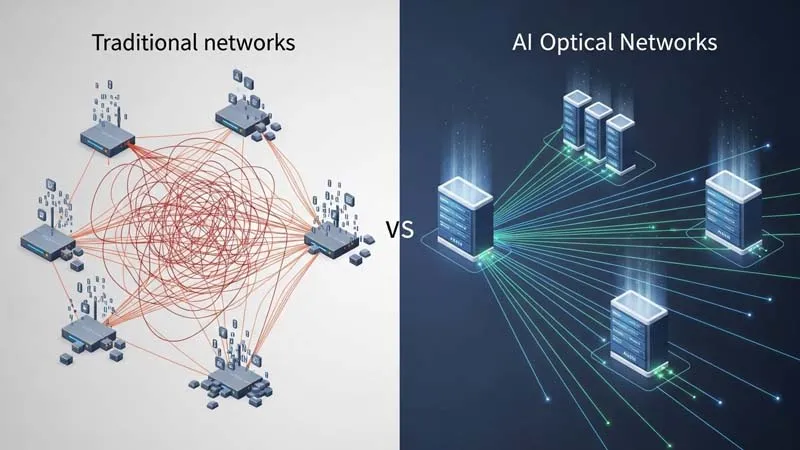
While the world obsesses over GPU shortages and model size, Goldman Sachs is betting big on the pipes connecting them. Their latest report projects the AI networking market will explode from $15 billion to $154 billion by 2028, a 10x growth driven entirely by the need to move data faster between AI clusters. The bottleneck isn't compute anymore—it's bandwidth. As models scale to trillions of parameters, the time spent moving data between GPUs and memory becomes the dominant cost. Optical networking, which uses light instead of electricity to transmit data, offers dramatically higher speeds and lower latency. This isn't just about fiber optics; it's about photonic interconnects, silicon photonics, and co-packaged optics that bring light directly to the chip. Companies like NVIDIA, Intel, and Marvell are already investing heavily, and startups in this space are seeing massive valuations. For builders, this means the next wave of AI infrastructure investment won't be in more GPUs but in the networking fabric that connects them. If you're building AI applications that require real-time data processing across distributed clusters, the quality of your networking will soon matter more than the raw compute power. The takeaway: start thinking about data locality and network topology now, because the era of infinite GPU bandwidth is ending.
Meine Einschätzung: GPUs get all the glory, but data movement is the real bottleneck. Optical networking is the unsung hero of the next AI infrastructure wave.
Deep Dive
Securing AI Agents with Command Guards
The release of destructive_command_guard on GitHub, which blocks dangerous git and shell commands from AI agents, highlights a critical gap in agent development: security. As AI agents gain the ability to execute code and interact with development environments, the risk of accidental or malicious damage grows exponentially. This isn't just about rogue agents—it's about simple mistakes. An agent tasked with refactoring code could accidentally run 'rm -rf /' if not properly sandboxed. The guard library works by intercepting shell commands and git operations, comparing them against a blacklist of dangerous patterns, and blocking execution with a clear error message. It's a simple but effective approach that any developer can integrate into their agent workflows today. The deeper lesson is that agent security needs to be treated as a first-class concern, not an afterthought. Most current agent frameworks focus on capability—what can the agent do?—without equal attention to constraint—what should the agent not do? This imbalance is dangerous as agents become more autonomous. To apply this today, start by defining a strict allowlist of commands your agent can execute, implement a guard layer that logs all attempted operations, and set up human-in-the-loop approval for any destructive actions. The open-source guard library is a great starting point, but the mindset shift is more important: treat every agent as a potential security vulnerability until proven otherwise.
Build like the agent is smarter than you—because it is, and it will make mistakes you never imagined.